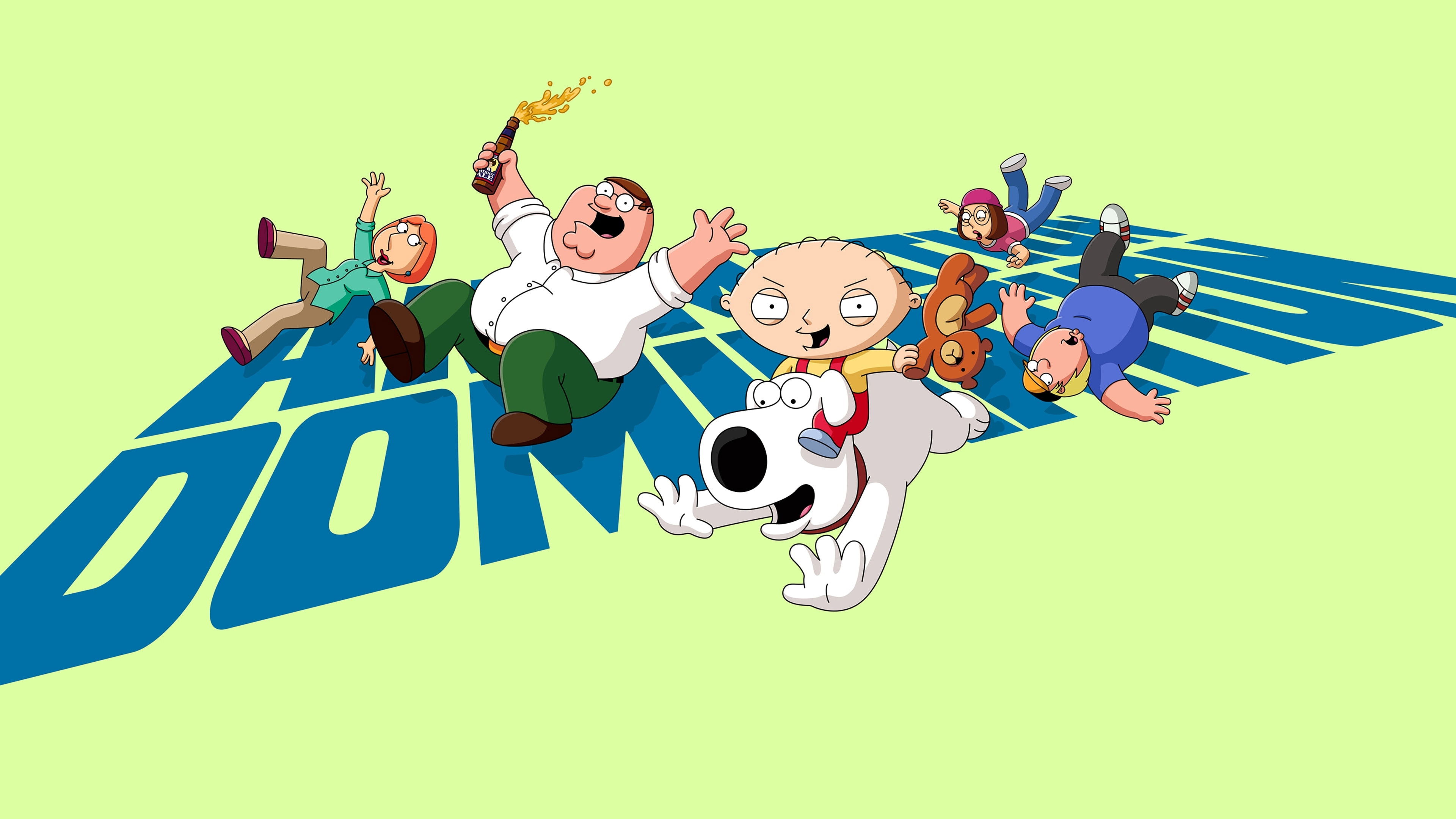
“Don't die laughing. We could get sued.”
The Enduring Anarchy of Quahog: Family Guy's Place in the Animated Pantheon
Since its debut on January 31, 1999, Seth MacFarlane's animated series, Family Guy, has carved out a distinctive, often controversial, niche in the landscape of American television comedy. Emerging in the wake of animated titans like The Simpsons and alongside the burgeoning irreverence of South Park, Family Guy immediately distinguished itself with a brand of humor described succinctly by its own overview as "sick, twisted, politically incorrect and Freakin' Sweet." Airing on FOX, the series introduced audiences to the dysfunctional Griffin family of Quahog, Rhode Island, quickly establishing a reputation for its rapid-fire gags, meta-commentary, and a willingness to push comedic boundaries that few other shows dared to approach. Its tagline, "Don't die laughing. We could get sued," encapsulates the show's audacious spirit and its self-aware embrace of its own provocative nature. As a returning series with an astonishing 24 seasons and 456 episodes to its name, Family Guy has not merely persisted; it has solidified its position as a cultural touchstone, constantly challenging audience expectations and the conventions of the animated sitcom genre.
Quahog's Unstable Reality: World-Building and Format Through the Fourth Wall
The world of Family Guy, centered in the fictional New England town of Quahog, is less a meticulously constructed universe and more a malleable canvas for comedic anarchy. Unlike animated series that establish a consistent internal logic, Quahog's reality is fluid, often bending or breaking entirely to serve a joke. This characteristic is intrinsically linked to the show's defining structural element: the cutaway gag. These non-sequitur vignettes, often lasting mere seconds, transport characters—or the audience's attention—to entirely different scenarios, historical events, or pop culture parodies, only to snap back to the primary narrative. This format fundamentally redefines traditional world-building. Instead of crafting a cohesive environment with established rules, Family Guy constructs a world where anything is possible, precisely because the narrative can abandon it at any moment. This intentional lack of consistency allows for a boundless comedic scope, enabling the series to comment on virtually any aspect of culture or society without being constrained by its own established lore. The town itself, while visually a generic American suburb, becomes a backdrop where the absurd is commonplace, and the fourth wall is not merely broken but frequently shattered, allowing characters to acknowledge their own fictionality or the mechanics of the show. This approach to world-building is not about immersion but about disruption, using the animated medium to explore the furthest reaches of comedic possibility.
Stagnation and Satire: The Griffin Family's Cyclical Character Arcs
At the heart of Family Guy's enduring appeal is the Griffin family, a quintet of archetypal sitcom characters whose individual quirks and collective dysfunction provide the bedrock for its humor. Peter Griffin, voiced by creator Seth MacFarlane, is the bumbling, impulsive patriarch whose idiocy often drives the plot. Lois Griffin, voiced by Alex Borstein, is the long-suffering, often exasperated matriarch, whose occasional lapses into depravity highlight the show's subversive tendencies. Their children include Meg (Mila Kunis), the perpetually unpopular and abused eldest daughter; Chris (Seth Green), the dim-witted middle child with a passion for movies; and Stewie (Seth MacFarlane), the brilliant, sadistic baby bent on matricide and world domination. Rounding out the family is Brian (Seth MacFarlane), the talking, martini-sipping dog who serves as Stewie's intellectual foil and the family's cynical voice of reason. Other notable voices include Patrick Warburton as Joe Swanson, the wheelchair-bound, perpetually angry neighbor, and Alex Borstein again as Tricia Takanawa, Loretta Brown, and Barbara Pewterschmidt, showcasing the versatility of the core cast.
Crucially, Family Guy, like many long-running animated sitcoms, largely eschews traditional character arcs in favor of comedic stasis. Peter remains profoundly unintelligent; Lois remains the grounded, yet occasionally unhinged, counterpoint; Meg's social standing never truly improves; Chris's mental acuity remains challenged; and Stewie's megalomaniacal ambitions, while occasionally softened by his bond with Brian, never fully dissipate. Brian, despite his intellectual pretensions and various romantic and existential crises, consistently reverts to his boozy, self-absorbed persona. This deliberate lack of significant character evolution is not a narrative weakness but a foundational element of the show's comedic and satirical approach. By keeping its characters largely fixed, the series can repeatedly place them in new, absurd, and often politically incorrect situations, relying on their established personalities for consistent comedic payoff. The humor arises from the clash between their unchanging natures and the ever-changing, often outrageous, scenarios they encounter. The voice actors are instrumental in maintaining these consistent characterizations, imbuing their roles with distinctive vocal tics and inflections that have become instantly recognizable. This cyclical nature allows Family Guy to function as a perpetual satire machine, resetting its characters to their default settings each episode to tackle new targets for its irreverent humor.
The Rhythmic Irreverence: Narrative Pacing Across Seasons and Episodes
The narrative pacing of Family Guy is as distinctive and unconventional as its humor. Individual episodes typically follow a primary plotline involving one or more members of the Griffin family, but this progression is frequently, and intentionally, interrupted by the show's signature cutaway gags. These brief, often surreal diversions create a unique, stop-start rhythm that differentiates Family Guy from more conventionally structured sitcoms. The pacing is rapid-fire, with jokes delivered at a high density, often requiring viewers to process multiple layers of humor—from slapstick and observational comedy to elaborate pop culture parodies and politically charged satire—within seconds. This constant comedic bombardment contributes to the "sick, twisted" energy that defines the series.
Across its remarkable 24-season run, the show's pacing has remained largely consistent in its episodic structure. While some multi-episode arcs have appeared (often involving Stewie and Brian's time travel adventures), the series predominantly adheres to a self-contained narrative model, ensuring that viewers can drop into any episode without significant prior knowledge. This episodic format, coupled with the reliance on cutaways, allows the show to maintain a high level of comedic output without the burden of complex serialized storytelling. The pacing ensures that even if a particular plotline falters, another joke or cutaway is always just around the corner, preventing stagnation. This relentless comedic rhythm, however, can also be perceived as a weakness by some, as it occasionally sacrifices emotional depth or character development for the sake of another laugh. Yet, for a show predicated on irreverence and a rejection of conventional narrative, this breakneck, interruption-heavy pacing is not merely a stylistic choice; it is integral to Family Guy's identity, enabling its sustained comedic impact over two decades.
The Unapologetic Id: A Verdict on Family Guy's Legacy
Family Guy stands as a monumental achievement in adult animated comedy, a testament to Seth MacFarlane's distinctive comedic vision and the enduring power of irreverence. Its primary strength lies in its unapologetic commitment to its "sick, twisted, politically incorrect" ethos. The show's willingness to tackle taboo subjects, lampoon cultural institutions, and employ dark humor has consistently pushed the boundaries of television comedy, influencing a generation of animated series. The rapid-fire comedic timing, the sheer volume of jokes, and the brilliant voice work by Seth MacFarlane, Alex Borstein, Mila Kunis, Seth Green, and Patrick Warburton, among others, contribute to its undeniable comedic potency. Its unique cutaway gag format, while often imitated, remains a hallmark of its creative genius, allowing for an unparalleled breadth of comedic reference and satire. Furthermore, the show's ability to maintain its core identity and comedic rhythm across 24 seasons and 456 episodes is a remarkable feat, speaking to the robustness of its format and characters.
However, Family Guy is not without its weaknesses. The very elements that define its strengths can, at times, become liabilities. The reliance on formulaic character dynamics and the deliberate lack of significant character growth can lead to perceived repetition, particularly for viewers seeking deeper narrative engagement. The show's controversial humor, while a core part of its appeal, occasionally veers into territory that some find gratuitous or offensive, crossing lines without always landing a substantial comedic or satirical punch. Its relentless pursuit of gags can sometimes overshadow coherent storytelling, making episodes feel like a collection of sketches rather than a cohesive narrative. For those who prefer subtle humor or character-driven drama, Family Guy's blunt, often shock-value approach may prove alienating.
Ultimately, Family Guy is a series best suited for viewers who appreciate audacious, meta-referential, and often politically incorrect humor. It appeals to an audience that enjoys rapid-fire jokes, pop culture parodies, and a show that isn't afraid to offend. It is for those who understand that its lack of traditional character arcs is a deliberate comedic choice, and that its world-building is intentionally unstable to serve the joke. As a cultural phenomenon, Family Guy has secured its place as a divisive yet undeniably influential force in television history, a show that, for over two decades, has dared its audience not to die laughing, lest they get sued.
Keep Reading
Television → Television · 2005
Criminal Minds
An elite team of FBI profilers analyze the country's most twisted criminal minds, anticipating their next moves before they strike again. T…
Read analysis → Television · 2000
CSI: Crime Scene Investigation
A Las Vegas team of forensic investigators are trained to solve criminal cases by scouring the crime scene, collecting irrefutable evidence…
Read analysis → Television · 2026
The WONDERfools
A goofy group of townies stumbles into superpowers and fights rising evil as doomsday panic grows in this wild, turn-of-the-century action…
Read analysis → Television · 2010
Running Man
These days, as variety shows are gradually disappearing, this is one of Korea’s representative variety shows that has been responsible for…
Read analysis →