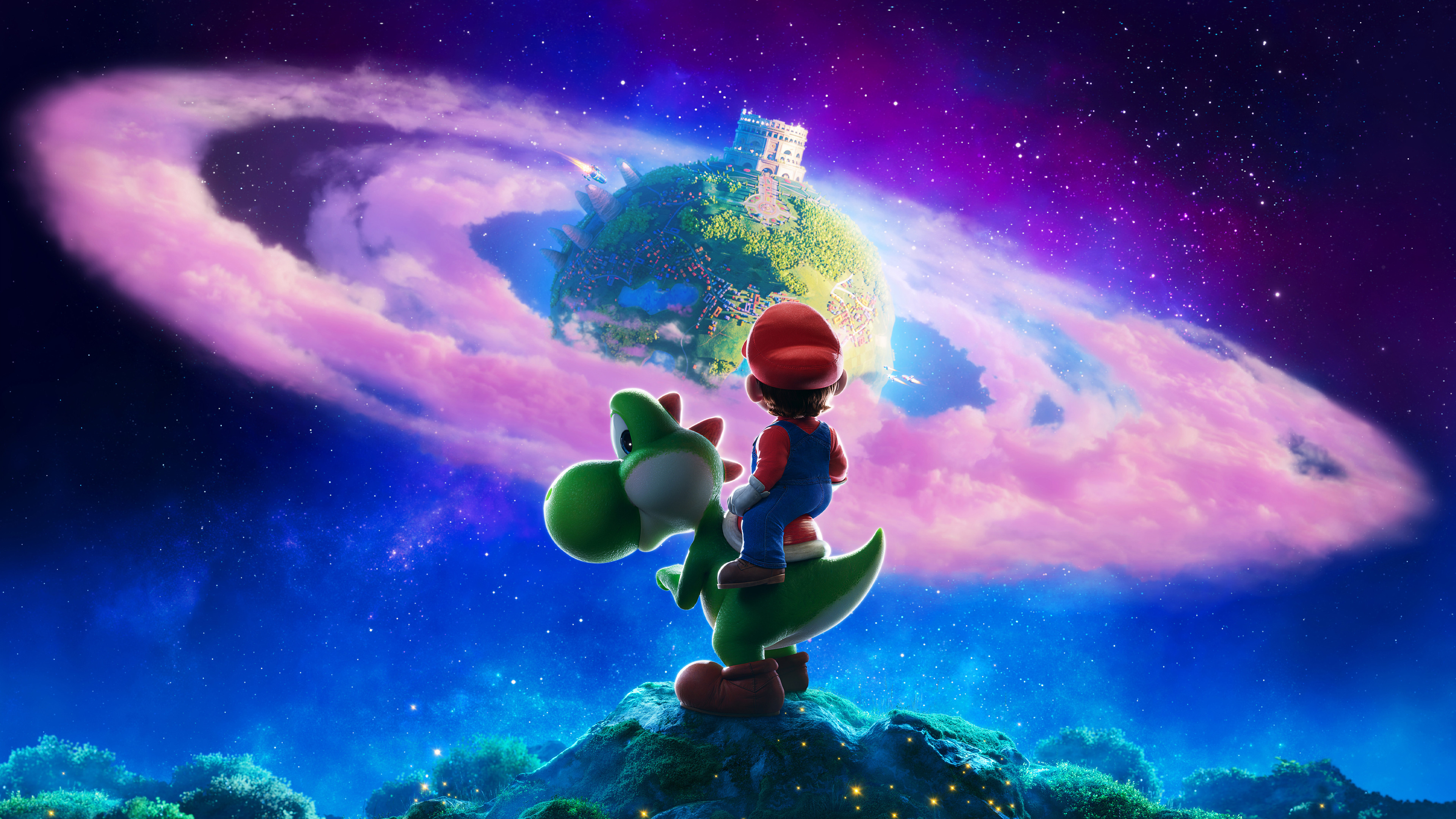
THE SUPER MARIO GALAXY MOVIE
Archive Entry No. 2026-PR
The Gravity of Legacy: A Cosmic Awakening in ‘The Super Mario Galaxy Movie’
When Nintendo and Illumination first brought the Mushroom Kingdom to the silver screen, it was a triumph of hyper-saturated nostalgia—a sensory burst of kinetic joy. Yet, in The Super Mario Galaxy Movie, directors Aaron Horvath and Michael Jelenic have transcended the brightly colored playpen of their debut to craft something unexpectedly sublime. This is not merely a sequel; it is a dizzying, existential leap into the cosmos that interrogates the very nature of heroism, villainy, and the crushing weight of inherited destiny. By launching its red-and-blue clad protagonists into the infinite void, the film transforms a beloved gaming franchise into a canvas for grand cinematic expression.
A Symphony of Gravitational Cinema
The cinematic experience of this film is defined by its revolutionary approach to space, movement, and perspective. Where its predecessor relied on lateral, side-scrolling momentum, this installment embraces spherical geometry. The camera orbits miniature planetoids with a dizzying, Keplerian elegance, challenging the audience’s relationship with up and down. Visually, the film is a masterclass in contrast. The deep, obsidian void of the cosmos is punctuated by the luminous, bioluminescent glow of Star Bits and the ethereal, pastel-hued sanctuary of the Comet Observatory.
It is an IMAX-level spectacle that feels less like a corporate intellectual property extension and more like a fever dream co-directed by Stanley Kubrick and Hayao Miyazaki. The sound design complements this visual vertigo perfectly, blending Koji Kondo’s iconic motifs with sweeping, Mahler-esque orchestral arrangements. The music does not merely accompany the action; it dictates the film's physical laws, pulling the audience through wormholes and across stardust with an irresistible gravitational pull.
The Voice of the Father and the Sovereign
At the heart of this cosmic drama is a surprisingly poignant exploration of character, brought to life by a voice cast operating at the peak of their dramatic capabilities. Chris Pratt’s Mario has matured; there is a weary, blue-collar stoicism to his performance now, balanced beautifully by Charlie Day’s Luigi, who finds a quiet, existential courage in the face of the infinite void.
However, the film’s true dramatic anchor is the introduction of Bowser Jr. Rather than a mere caricature of juvenile malice, the young heir is portrayed as a tragic figure trapped in the shadow of his father’s defeat. His quest to liberate Bowser from captivity is not driven by a desire for conquest, but by a desperate, heartbreaking need for paternal validation and the restoration of a fractured family legacy. The vocal performance captures this tension beautifully, transforming what could have been a standard rescue plot into a gripping psychological duel between two generations of sons trying to define themselves outside of their fathers' shadows.
The Cycle of Filial Piety and Modern Mythmaking
In an era dominated by cultural discussions of generational trauma and the dismantling of systemic legacies, the film feels remarkably urgent. It asks a fundamental question: are we doomed to repeat the crusades of our predecessors? Bowser Jr.’s campaign to restore his family’s empire mirrors our contemporary anxieties regarding the preservation of outdated dogmas.
The film refuses to offer easy answers. It does not demonize the young antagonist; instead, it views him through a lens of profound empathy. By framing the conflict around the liberation of a captive father, the narrative forces Mario and Luigi to confront their own roles as enforcers of the status quo. It is a sophisticated thematic turn that elevates the film from a simple binary of good versus evil into a nuanced meditation on reconciliation and the possibility of breaking cyclical cycles of violence.
Ultimately, The Super Mario Galaxy Movie is a triumph of modern animation. It proves that blockbusters can be both populist spectacles and deeply intellectual artistic statements. By launching its characters into the stars, the film has paradoxically grounded them in the most human struggles of all.