THE DARK KNIGHT
Archive Entry No. 2008-PR
A Monument of Modern Myth: Re-evaluating Christopher Nolan’s *The Dark Knight*
Released in the summer of 2008, Christopher Nolan’s The Dark Knight did not merely redefine the boundaries of the superhero genre; it shattered the glass ceiling of what blockbuster cinema could artistically achieve. Arriving at a cultural inflection point, the film elevated the comic-book adaptation into a grave, grand-scale crime epic, drawing legitimate comparisons to Michael Mann’s Heat and Fritz Lang’s urban nightmares. Sixteen years after its premiere, the film remains a towering achievement, preserved not just as a cultural phenomenon, but as a masterclass in cinematic tension, philosophical inquiry, and visual scale.
The Architect of a Cinematic Paradigm Shift
The legacy of The Dark Knight is inextricably linked to its revolutionary impact on the film industry. Prior to 2008, comic-book films were largely viewed by critics as adolescent escapism. Nolan, however, treated the mythology of Gotham City with absolute solemnity. The film’s cultural gravity was so immense that its omission from the Best Picture category at the 81st Academy Awards prompted the Academy to expand its nominee field from five to ten films—a systemic change colloquially known as "The Dark Knight Rule."
Central to this legacy is the late Heath Ledger’s transcendent, posthumously Oscar-winning performance as the Joker. Ledger did not play a cartoon villain; he embodied a terrifying, metaphysical force of nature. His portrayal of anarchic terror redefined the cinematic antagonist, casting a shadow so long that almost every blockbuster villain since has attempted, and largely failed, to replicate its chaotic energy. Ledger’s performance anchored the film in a terrifying reality, ensuring its place in the pantheon of cinematic history.
The Fragility of Order and Post-9/11 Anxieties
The enduring power of The Dark Knight lies in its rich, thematic complexity. It is a deeply political film, acting as a mirror to the anxieties of the post-9/11 era. Nolan and co-writer Jonathan Nolan construct a narrative that interrogates the ethics of the War on Terror. When Batman implements a massive, invasive sonar surveillance network to track the Joker, the film directly engages with the moral compromises of the Patriot Act. It asks a haunting question: how much of our civil liberties must we sacrifice to defeat an enemy who respects no rules?
Furthermore, the film is a profound exploration of escalation and the fragility of human civilization. The Joker is not motivated by wealth or power, but by a desire to expose the hypocrisy of societal structures. The tragic descent of Harvey Dent into Two-Face serves as the film’s moral core. Dent’s transformation from Gotham’s "White Knight" to a cynical arbiter of chance illustrates the terrifying ease with which institutional justice can degrade into nihilism when pushed to its absolute limit.
The Celluloid Sublime: Wally Pfister’s Visual Legacy
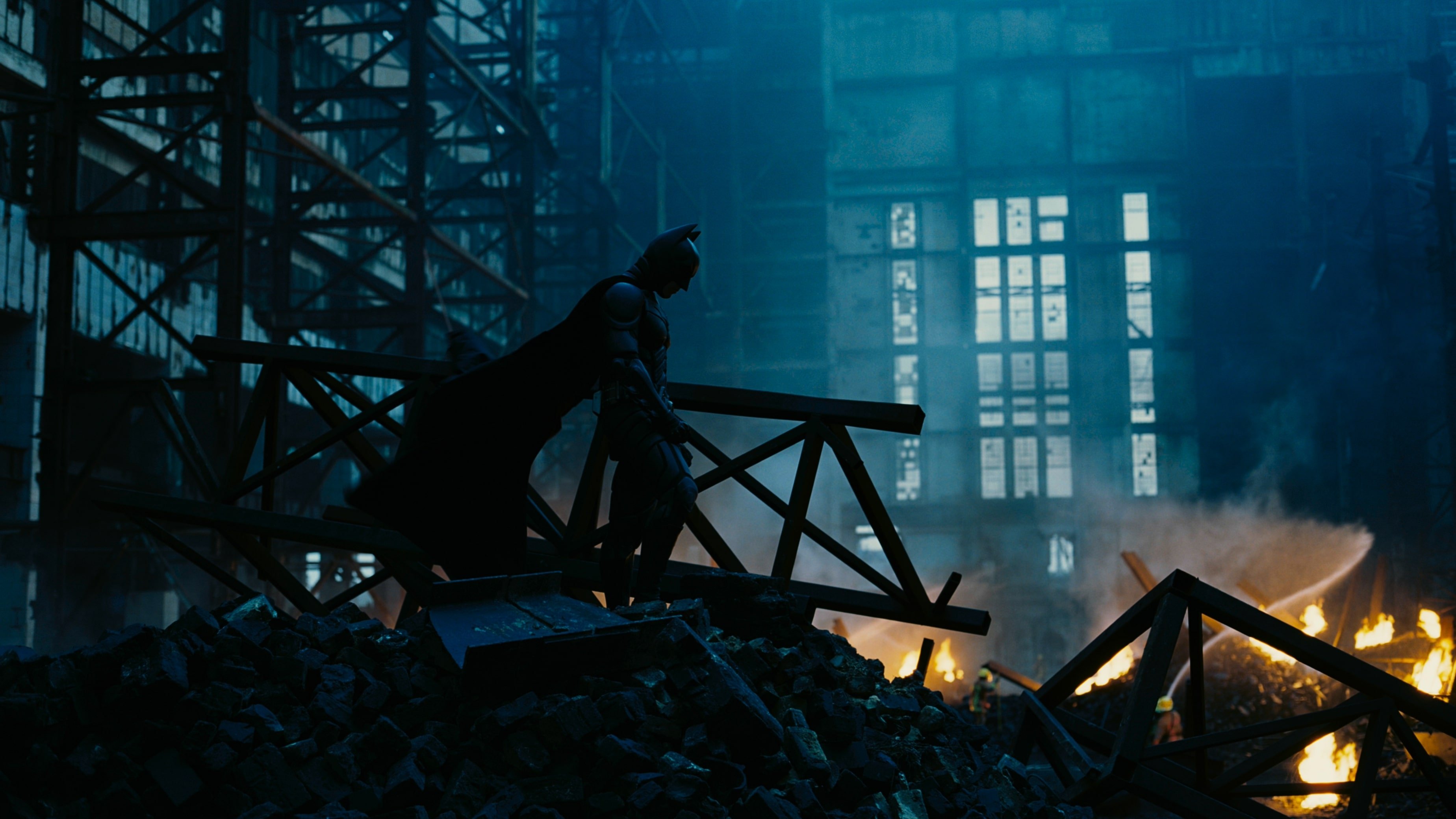
Perhaps the most remarkable aspect of The Dark Knight today is how spectacularly its cinematography holds up in an era dominated by flat, green-screen digital aesthetics. Director of Photography Wally Pfister’s work on the film—which earned him an Academy Award nomination—remains a high-water mark for modern action cinema. This was the first major studio feature to utilize high-resolution IMAX 15/70mm cameras, a choice that gave the film an unprecedented sense of verticality and tactile realism.
Pfister’s cinematography eschews the murky, hyper-stylized shadows of previous Batman iterations in favor of a crisp, naturalistic palette. Gotham is rendered not as a gothic fantasy, but as a cold, steel-and-glass metropolis. The daylight scenes are bathed in a harsh, clinical glare, while the night sequences glow with the amber warmth of sodium-vapor streetlights and the cool blue of fluorescent skyscrapers. By shooting on location and prioritizing practical effects—such as the famous flipping of an actual eighteen-wheeler in the heart of Chicago—Pfister and Nolan achieved a physical weight and spatial clarity that contemporary CGI-heavy blockbusters simply cannot replicate. Every frame feels tangible, dangerous, and monumental.
Ultimately, The Dark Knight endures because it refused to compromise. It treated its audience with intellectual respect, offering a dark, complex, and visually stunning autopsy of the modern soul. It remains the definitive cinematic myth of our time.