SCHINDLER'S LIST
Archive Entry No. 1993-PR
Monuments of Memory: A Retrospective on Steven Spielberg’s Schindler’s List
Released on December 15, 1993, Schindler's List marked a watershed moment in American cinema. It was the precise juncture at which Steven Spielberg, previously celebrated as the master of escapist blockbusters, fully transitioned into a serious historical chronicler. The film did not merely depict the Holocaust; it fundamentally reshaped how the modern world visualizes and remembers it. Decades after its release, it remains a towering achievement of narrative cinema—a devastating, essential exploration of humanity's capacity for both unimaginable cruelty and profound grace.
The Monochrome Eye: Janusz Kamiński’s Visual Legacy
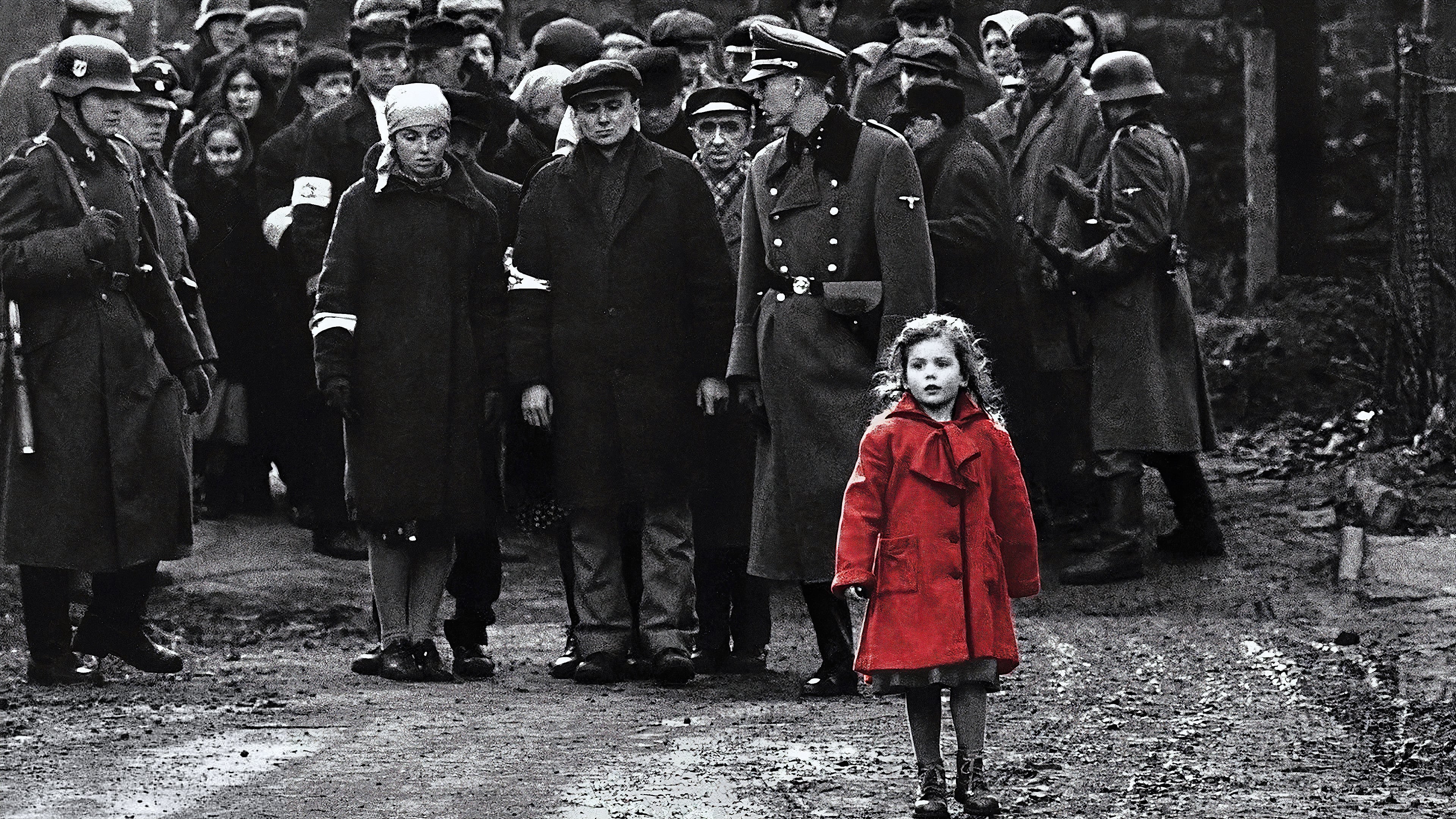
To examine Schindler’s List today is to marvel at the enduring power of its visual language. Director of photography Janusz Kamiński, in his first collaboration with Spielberg, made the radical decision to shoot the film almost entirely in black-and-white. This was not a mere stylistic gimmick, but a deliberate attempt to evoke the stark, documentary-style realism of World War II newsreels. Today, this cinematography holds up spectacularly, avoiding the glossy romanticism of typical Hollywood period dramas.
Kamiński’s use of high-contrast chiaroscuro lighting creates a world of sharp moral divides and murky ethical shadows. The camera is often restless, utilizing hand-held movements that immerse the viewer in the terror of the Kraków Ghetto liquidation. This cinema-verité approach strips away the distance of time, making the historical horror feel immediate and urgent. Of course, the sparing use of color—most famously the girl in the red coat—remains a masterclass in visual symbolism. It serves as a focal point of awakening for Oskar Schindler and a heartbreaking metaphor for the world's complicity and inaction, a poetic rupture in an otherwise bleak, documentary reality.
The Geometry of Mercy and the Banality of Evil
At the heart of the film lies a complex thematic duality: the terrifying banality of evil, embodied by Ralph Fiennes’ chilling portrayal of Amon Goeth, contrasted with the gradual moral awakening of Oskar Schindler, played with magnificent nuance by Liam Neeson. Spielberg avoids sanctifying Schindler. Instead, we see a flawed, opportunistic war profiteer who slowly realizes that his wealth is meaningless unless leveraged to preserve human life.
The film’s enduring theme is the power of individual agency within an overwhelming system of industrial slaughter. The Talmudic proverb quoted in the film, "Whoever saves one life saves the world entire," serves as its moral anchor. In an era increasingly defined by systemic apathy and geopolitical instability, this exploration of personal responsibility and the agonizing calculus of mercy feels more urgent than ever. Spielberg balances the macro-history of the Holocaust with the micro-history of individual survival, ensuring the victims are never reduced to mere statistics.
A Cultural Monument and the Preservation of Truth
The legacy of Schindler’s List extends far beyond the confines of movie theaters. Its critical and commercial triumph catalyzed the creation of the USC Shoah Foundation, dedicated to recording the testimonies of survivors and witnesses of the Holocaust and other genocides. In this way, the film transcended art to become an instrument of historical preservation. In today’s digital age, where historical revisionism and denialism proliferate online, the film's meticulous reconstruction of historical atrocity stands as an unyielding bulwark against forgetting.
Conclusion: An Uncompromising Masterpiece
Ultimately, Schindler’s List holds up not just as a historical document, but as an artistic triumph of the highest order. It is a film that refuses to offer easy catharsis. By juxtaposing the horrific reality of the Shoah with a singular story of survival, Spielberg crafted a work of art that is simultaneously agonizing to watch and impossible to forget. It remains a definitive touchstone of global cinema, proving that film can be both a mirror to our darkest past and a beacon for our moral future.