PULP FICTION
Archive Entry No. 1994-PR
A Postmodern Watershed: Re-evaluating *Pulp Fiction* Three Decades Later
When Quentin Tarantino’s Pulp Fiction burst onto the screen in the autumn of 1994, it did not merely capture the cultural zeitgeist; it seismically shattered the conventional boundaries of narrative cinema. Winning the Palme d'Or at Cannes and securing its place as a cultural touchstone, the film signaled the definitive arrival of postmodernism in the American mainstream. Thirty years later, as cinema historians, we must look past the film's ubiquitous pop-culture iconography to examine the structural, thematic, and visual mechanics that preserve its status as an enduring masterpiece of modern cinema.
The Architecture of a Postmodern Legacy
The legacy of Pulp Fiction is inextricably linked to its structural audacity. By dismantling the traditional linear three-act structure and reassembling it as a chronological mosaic, Tarantino challenged the audience's cognitive relationship with cinematic time. The film did not just popularize non-linear storytelling; it democratized it, proving that mainstream audiences could navigate complex temporal loops if anchored by compelling, rhythmic dialogue.
Furthermore, the film catalyzed the 1990s American independent film boom, transforming Miramax into an empire and demonstrating that high-art narrative experimentation could yield massive commercial success. It resurrected the career of John Travolta, solidified Samuel L. Jackson as a singular theatrical force, and established a new cinematic lexicon that merged highbrow literary ambition with the visceral thrills of lowbrow exploitation cinema. Its influence remains visible in the DNA of contemporary television and film, which routinely utilizes fractured timelines and conversational digressions as standard narrative tools.
The Sacred and the Profane: Enduring Themes
Beneath the film's hyper-stylized violence and ironic banter lies a deeply moral, almost theological inquiry. The enduring thematic resonance of Pulp Fiction stems from its preoccupation with redemption, fate, and divine intervention. The narrative acts as a series of existential tests for its characters. Jules Winnfield’s transition from a cold-blooded assassin to a spiritual wanderer—triggered by a "miracle" of missed bullets—serves as the moral spine of the film.
This spiritual awakening stands in stark contrast to his partner, Vincent Vega, who rejects the transcendent nature of their survival and is ultimately undone by his complacency. Similarly, Butch Coolidge’s narrative arc is one of honor and resurrection; he risks his life and freedom to save his enemy, Marsellus Wallace, from a basement of horrors. Tarantino juxtaposes the banal—discussions of European McDonald’s menus and foot massages—with the existential, suggesting that grace and damnation are negotiated not in grand cathedrals, but in the grime of Los Angeles diners, pawn shops, and nondescript apartments.
The Tactile Frame: Andrzej Sekuła’s Cinematography Today
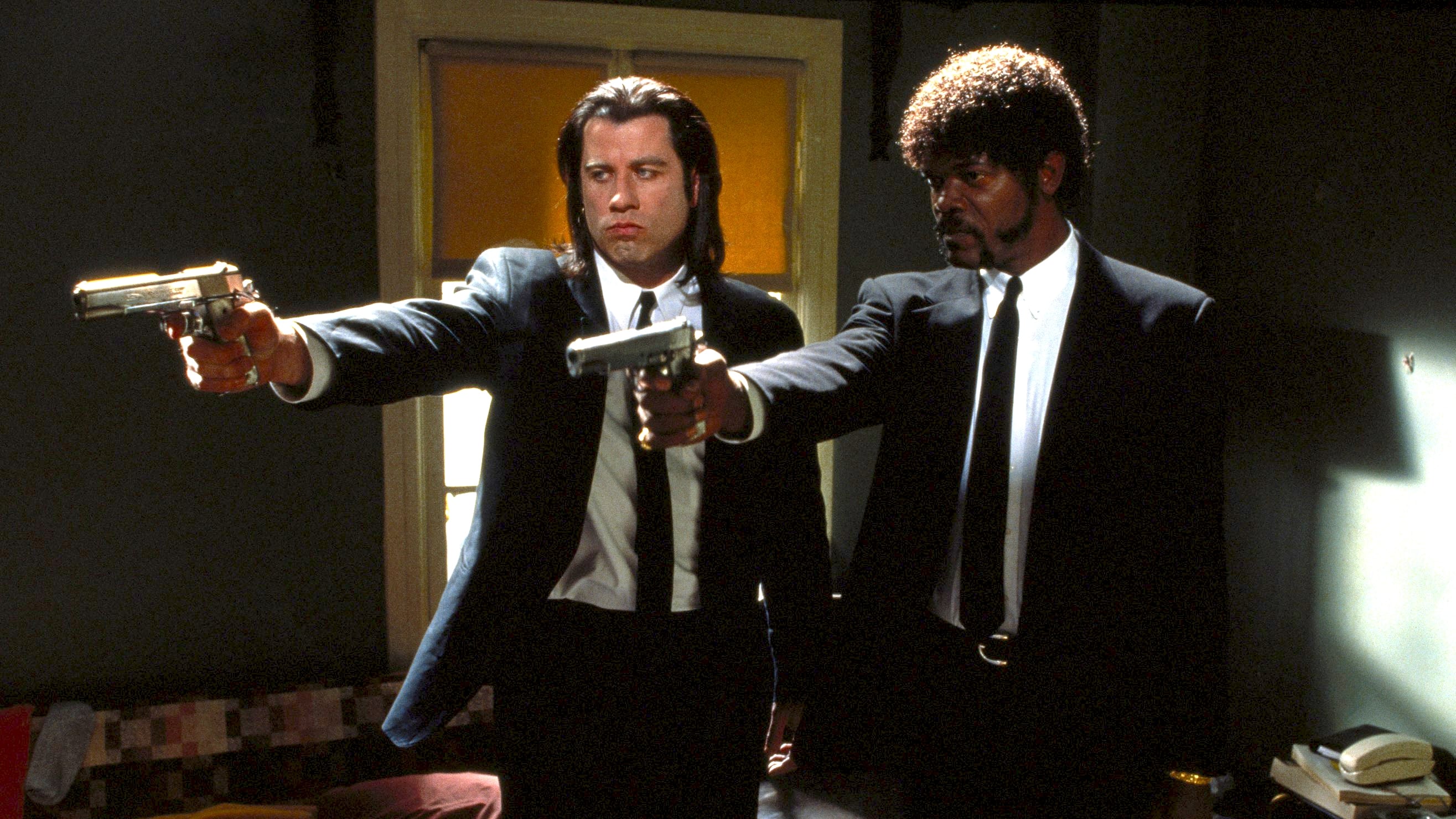
In an era dominated by sterile digital sensors and flat, high-key lighting, the cinematography of Andrzej Sekuła in Pulp Fiction holds up remarkably well, offering a masterclass in celluloid texture. Shot on 50 ASA Eastman film stock—the slowest, finest-grained film available at the time—the movie possesses an extraordinary visual clarity and a saturated, glossy color palette that feels incredibly tactile today.
Sekuła’s camera does not rely on frantic, handheld movement to generate energy. Instead, it employs formal, elegant compositions, wide-angle lenses, and deep-focus staging that allow the actors to dominate the space. The iconic low-angle "trunk shot," the voyeuristic, floating tracking shots through Jack Rabbit Slim’s, and the extreme, clinical close-ups of Mia Wallace’s lips and Vincent’s syringe create a heightened, hyper-real sensory experience. This deliberate, neo-noir lighting and rich contrast give the film a weight and presence that digital cinematography struggles to replicate, ensuring its visual permanence in the digital age.
Ultimately, Pulp Fiction remains a towering achievement because it functions simultaneously as a love letter to the history of cinema and a bold step into its future. Its brilliant synthesis of form, theme, and visual style ensures that it remains as vital, shocking, and intellectually stimulating today as it was in 1994.