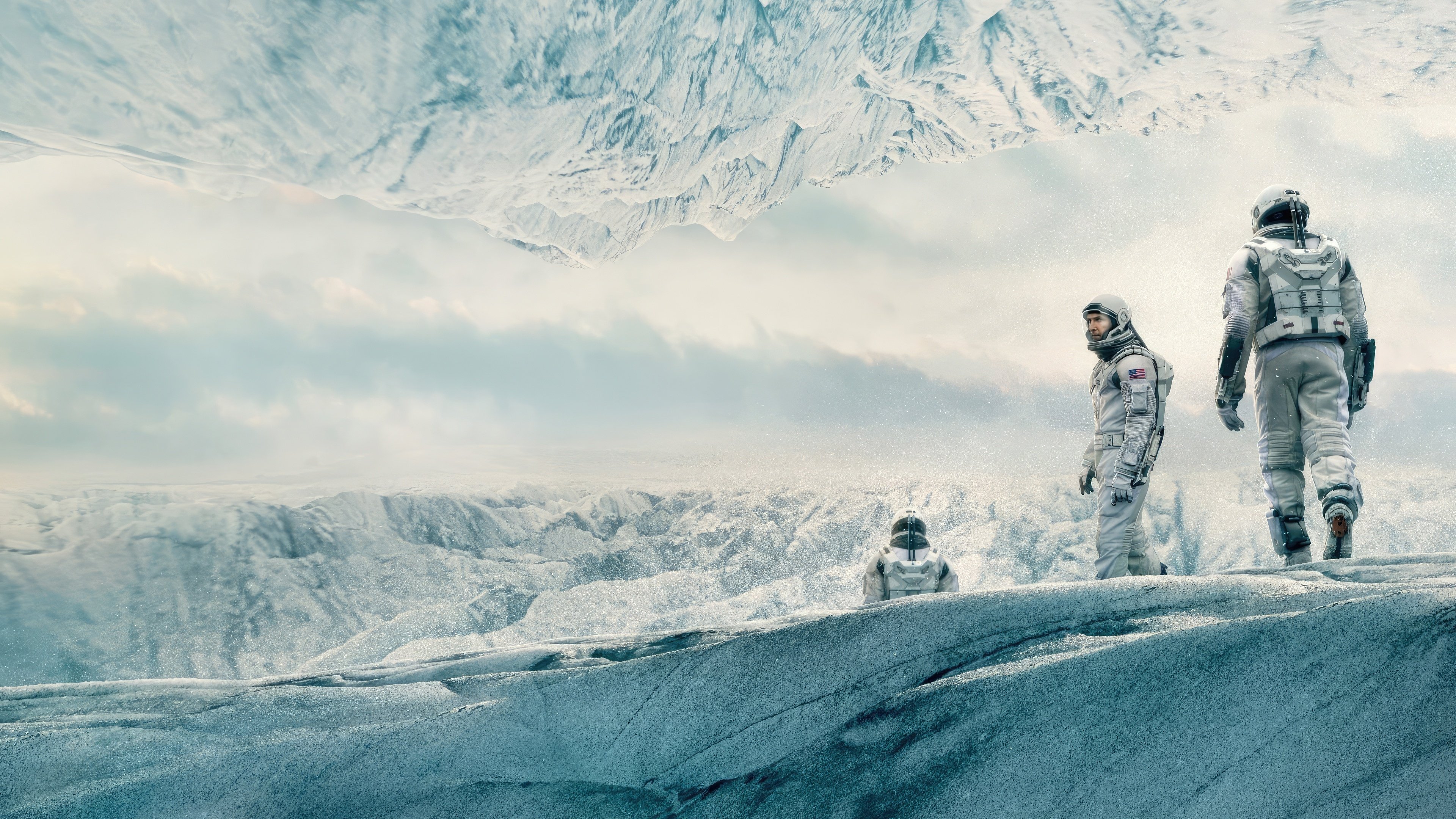
INTERSTELLAR
Archive Entry No. 2014-PR
The Cosmic Scale of Humanism: A Decade of *Interstellar*
A decade after its release in November 2014, Christopher Nolan’s Interstellar stands not merely as a monumental achievement in hard science fiction, but as a pivotal landmark in 21st-century cinema. While contemporary critics initially debated the friction between its rigorous theoretical physics and its unabashed emotional earnestness, time has been exceptionally kind to this cosmic epic. Today, cinema historians recognize it as a modern masterpiece that successfully bridged the gap between the chilly, intellectual isolation of Stanley Kubrick’s 2001: A Space Odyssey and the Spielbergian warmth of familial devotion.
The Gravity of Love: Enduring Thematic Paradoxes
At the heart of Interstellar lies a profound thematic paradox: the tension between the macro-survival of the human species and the micro-survival of the individual family. Nolan, co-writing with his brother Jonathan, uses the vast, silent canvas of a dying Earth and an indifferent cosmos to explore the intimate dynamics of paternal grief and promise. The film’s central thesis—that love is not a mere evolutionary utility, but an observable, quantifiable force capable of transcending dimensions of time and space—remains its most daring intellectual proposition.
By framing gravity and love as parallel anomalies that can breach the boundaries of the space-time continuum, the narrative elevates a desperate salvage mission into a spiritual odyssey. Cooper’s journey is not merely outward into the black void of the wormhole, but inward, back to the bedroom of his daughter, Murphy. In an era of cinema dominated by cynical dystopias, Interstellar’s enduring legacy is its unfashionable optimism: it positions humanity's salvation not in our technological supremacy, but in our capacity for emotional connection across the abyss.
The Cinematographic Sublime: Hoyte van Hoytema’s Celluloid Cosmos
Visually, the film remains a towering achievement, largely due to the masterful cinematography of Hoyte van Hoytema, marking his first collaboration with Nolan. Shot on a combination of 35mm anamorphic and 15-perf 65mm IMAX film, the movie rejects the sterile, green-screen-heavy aesthetics of its contemporaries in favor of a tactile, organic grandeur. Today, this imagery holds up spectacularly, outshining the flat, digital look of modern blockbusters.
Van Hoytema’s camera captures the choking, sepia-toned dust of a dying American Midwest with the same reverent intimacy as the terrifying majesty of the wormhole near Saturn. The decision to project pre-rendered astrophysical simulations onto massive screens on set—rather than relying on post-production green screens—imbued the spacecraft interiors and the actors' faces with a genuine, reflected cosmic light.
Furthermore, the depiction of the supermassive black hole, Gargantua, developed in tandem with Nobel laureate Kip Thorne, remains a landmark in both cinematic visual effects and scientific visualization. The rendering of the gravitational lensing of light around the event horizon possesses a terrifying, sublime beauty that digital-only filmmaking rarely achieves. By anchoring the cosmic scale in physical camera movements and real-world lighting, van Hoytema achieved a sense of documentary realism within the fantastic.
The Lasting Orbit of Nolan's Magnum Opus
Ultimately, Interstellar’s legacy is defined by its audacious scale and its refusal to compromise on either its scientific curiosity or its emotional core. It stands as a testament to the power of celluloid filmmaking in an increasingly digital age. As we look back, Nolan’s odyssey does not feel like a relic of 2014, but rather a timeless beacon—a cinematic wormhole that continues to draw audiences into its gravity, reminding us of our fragile place in the cosmos and the enduring power of the human spirit.