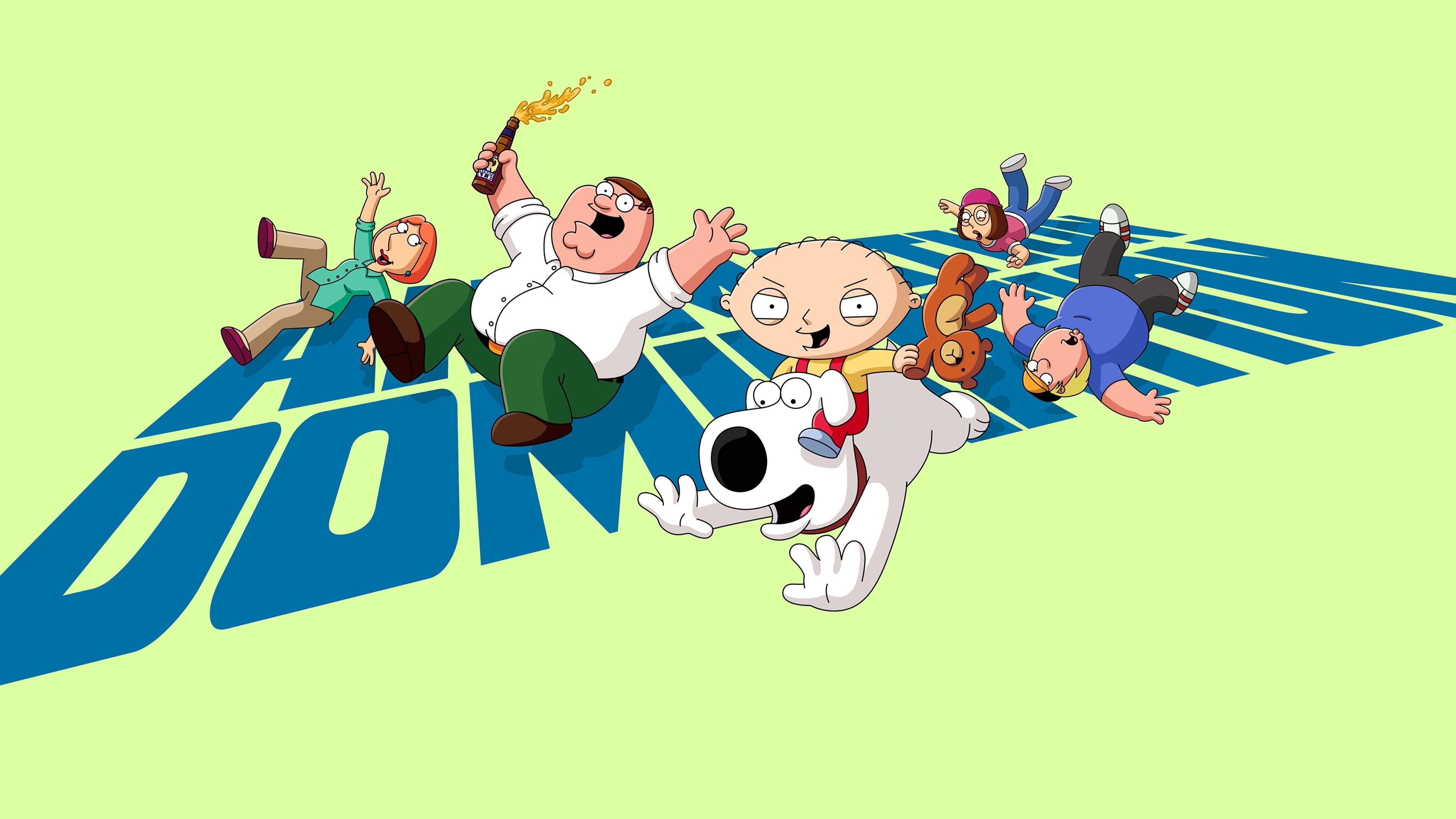
FAMILY GUY
Archive Entry No. 1999-PR
The Dadaist Subversion of the American Sitcom: A Critical Autopsy of Family Guy
Since its debut on January 31, 1999, Seth MacFarlane’s Family Guy has occupied a polarizing, yet undeniably influential, space in the cultural zeitgeist. Often dismissed by detractors as a crude exercise in shock value and non-sequiturs, a closer critical autopsy reveals a sophisticated, Dadaist deconstruction of the American domestic sitcom. It is a television text that simultaneously worships and desecrates the medium, using the framework of the nuclear family to explore the anxieties of a media-saturated society.
The Elasticity of Quahog: Surrealism in the Suburbs
Quahog, Rhode Island, is not merely a setting; it is an elastic, ontological playground. Unlike the grounded, satirical realism of Springfield in The Simpsons, Quahog operates under a physics of pure convenience. It is a landscape where anthropomorphic canines debate theology, infants construct temporal displacement devices in their playpens, and a localized dispute with a man in a giant chicken suit can level entire city blocks.
This world-building relies on a unique brand of magical realism, where the bizarre is greeted with mundane indifference by the town's populace. The true genius of Quahog’s architecture lies in its porous boundaries. Through the show’s signature cutaway gags, the narrative space is constantly punctured, allowing historical figures, pop-culture detritus, and existential dread to bleed into the domestic sphere. It is a hyper-mediated world where reality is defined not by geography or history, but by television history itself.
Character Arcs: The Tragedy of Stasis and the Illusion of Growth
In traditional television, character arcs imply evolution, moral education, or emotional maturation. Family Guy, however, champions a post-modern stasis, utilizing the sitcom "reset button" to comment on the cyclical, trap-like nature of suburban existence. Yet, beneath this structural paralysis, subtle and tragic shifts occur, most notably in the dialectic between Stewie and Brian Griffin.
Initially framed as a Shakespearean, matricidal supervillain and a sophisticated, martini-sipping voice of reason, their trajectories have fascinatingly inverted over the decades. Stewie has softened, his homicidal rage sublimating into a queer-coded, existential melancholy and a desperate need for platonic intimacy. Conversely, Brian has degenerated from a noble intellectual into a devastating portrait of liberal pretension, creative impotence, and moral hypocrisy. They are two sides of the same coin: the tragedy of wasted potential. Meanwhile, Meg’s evolution into the family’s punching bag serves a darker, ritualistic function—she is the lightning rod for the family’s collective dysfunction, a scapegoat whose systematic abuse maintains the fragile equilibrium of the household.
Narrative Pacing: The Hyper-Fragmented Rhythm of Attention-Deficit Theater
The narrative pacing of Family Guy represents a radical departure from classical Hollywood storytelling. It pioneered what can be termed "attention-deficit theater." Rather than relying on a linear progression of cause and effect, the show’s pacing is dictated by associative logic. A traditional A-plot (such as Peter’s latest buffoonish career pivot) and B-plot (Lois’s domestic frustration) are constantly interrupted, refracted, and delayed by the cutaway gag.
This creates a unique rhythmic tension. The narrative does not flow; it stutters, leaps, and loops. This hyper-fragmentation anticipated the fractured attention spans of the internet age, transforming the viewing experience into a series of rapid-fire, algorithmic dopamine releases. It is a pacing style that prioritizes the micro-joke over macro-coherence, challenging the viewer to find meaning not in the narrative destination, but in the chaotic, cultural detours.
Ultimately, Family Guy remains a monument to post-modern cynicism. By dismantling the traditional structures of world-building, character development, and narrative pacing, it mirrors the fragmented, media-saturated consciousness of the late 20th and early 21st centuries. It is a brilliant, exhausting, and essential critique of the American dream, wrapped in the colorful packaging of a Saturday morning cartoon.