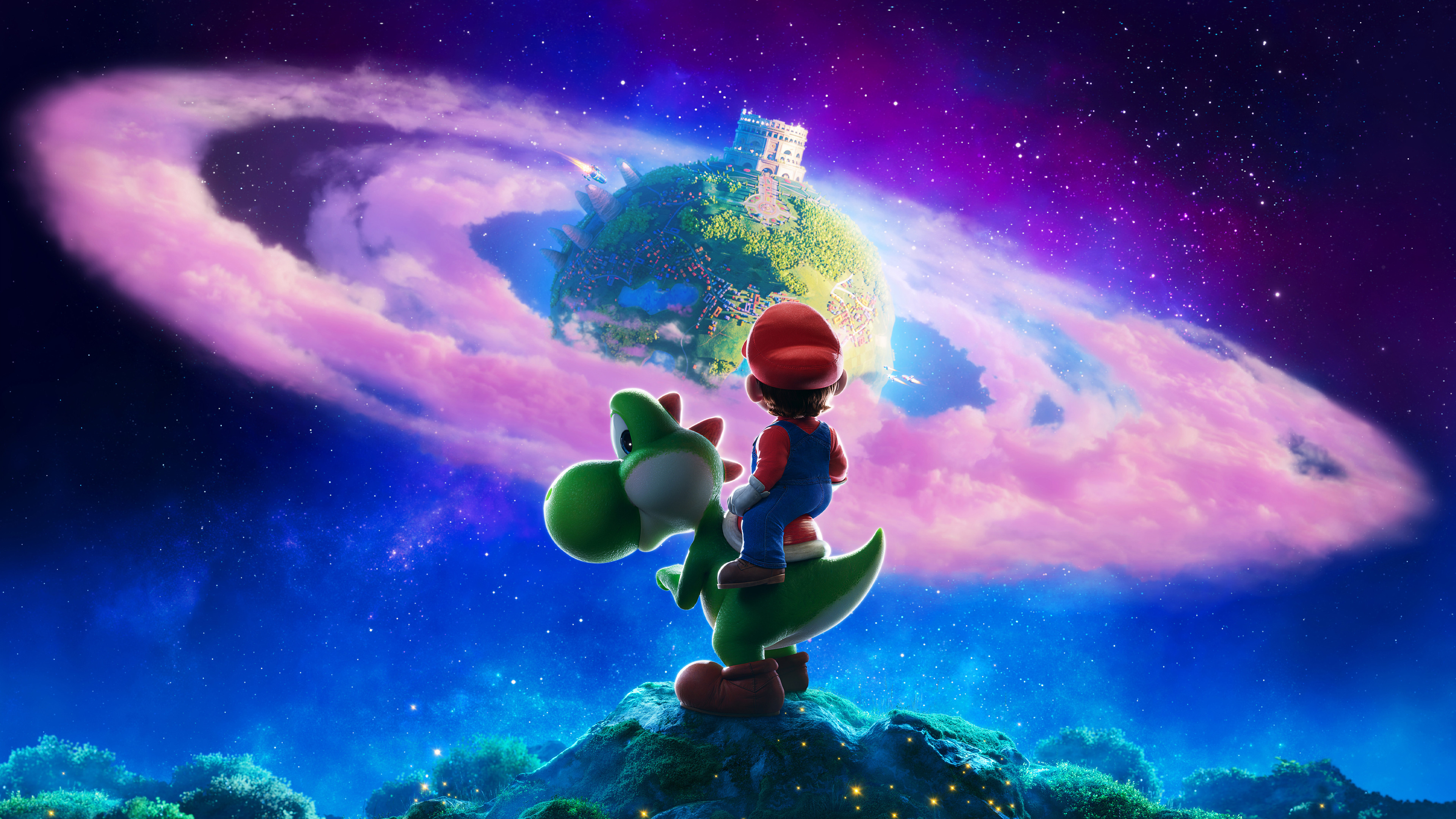
The Super Mario Galaxy Movie

"Having thwarted Bowser's previous plot to marry Princess Peach, Mario and Luigi now face a fresh threat in Bowser Jr., who is determined to liberate his father from captivity and restore the family legacy. Alongside companions new and old, the brothers travel across the stars to stop the young heir's crusade."
A Cosmic Leap Forward: The Audacious Vision of 'The Super Mario Galaxy Movie'
When Illumination and Nintendo first brought the Mushroom Kingdom to the silver screen in 2023, they delivered a kinetic, reference-heavy love letter to gaming history. However, its narrative was deliberately straightforward—a safe, crowd-pleasing origin story. Enter The Super Mario Galaxy Movie (released April 1, 2026), a sequel that does not merely step forward; it launches itself into orbit. Directed by the returning duo of Aaron Horvath and Michael Jelenic, this cinematic odyssey transforms a vibrant franchise into a visually staggering, emotionally resonant epic. By shifting the arena from the terrestrial landscapes of Peach’s Castle to the mind-bending physics of the cosmos, the filmmakers have crafted a sequel that excels in narrative depth, artistic experimentation, and character complexity.
The film’s premise is deceptively simple: following Bowser’s humiliating defeat and subsequent imprisonment in a miniature jar, his pint-sized heir, Bowser Jr., assumes control of the Koopa Troop. Driven not by a desire for global domination, but by a poignant, desperate urge to restore his father’s honor and secure his own legacy, the young prince orchestrates a daring campaign across the stars to retrieve the Grand Stars. Mario and Luigi must team up with a mysterious cosmic matriarch, Rosalina, and travel through bizarre, gravity-defying galaxies to prevent a cataclysmic family reunion. What follows is a space opera that balances whimsical Nintendo charm with genuine emotional stakes.
Legacy and the Burden of the Crown: Key Thematic Currents
At the beating heart of The Super Mario Galaxy Movie is the theme of filial legacy and the weight of familial expectation. Unlike his father, whose villainy in the first film was fueled by ego and unrequited lust, Bowser Jr. is driven by a far more sympathetic motivator: the desire to be seen, loved, and validated by his father. The filmmakers treat Bowser Jr.’s quest with a surprising level of psychological maturity. He is not merely a bratty antagonist; he is a child thrust into a leadership role, donning a bandana painted with a monstrous fang to mask his own vulnerability. The film cleverly contrasts the toxic, pressure-cooker dynamic of the Koopa family with the supportive, egalitarian brotherhood of Mario and Luigi.
Furthermore, the narrative explores the concept of existential loneliness and found family through the character of Rosalina. As the protector of the Lumas—sentient, star-like entities that eventually supercharge Mario’s abilities—Rosalina represents a melancholic counterweight to the frantic energy of the plumbing brothers. Her backstory, delivered via a beautifully stylized, storybook-like flashback, introduces a quiet grief to the film. She is a maternal figure who has accepted the vast, cold isolation of space, finding purpose only in nurturing others. The thematic intersection of Bowser Jr.’s desperate search for a parent and Rosalina’s quiet adoption of orphans elevates the film from a simple rescue mission to a profound meditation on what it means to belong.
Orchestrating the Cosmos: Cinematography and Visual Design
How do you translate the revolutionary, gravity-shifting gameplay of a 3D masterpiece into a linear cinematic experience? The answer lies in the film's extraordinary "camera" work and lighting design. While animated, the cinematography of The Super Mario Galaxy Movie—steered by virtual director of photography cinematographers—functions with the sophistication of a live-action space epic. The film employs a dynamic, swooping camera that constantly reorients the horizon, mimicking the disorienting, spherical physics of the original Wii games.
Visual highlights of this technique include:
- The Gusty Garden Sequence: A breathtaking long take where Mario and Luigi are propelled by launch stars through a cluster of asteroid gardens. The camera spirals around them, capturing the exhilarating sensation of weightlessness and centrifugal force while maintaining absolute spatial clarity.
- The Melty Molten Galaxy Confrontation: A visually striking sequence dominated by high-contrast lighting. Here, the warm, threatening glow of molten rock clashes with the cold, unforgiving blue of deep space, mirroring Bowser Jr.'s inner turmoil.
- The Comet Observatory: Designed as a sanctuary of peace, this hub world utilizes soft, diffuse, bioluminescent lighting. The pastel blues, purples, and golds wash over the characters, creating a dreamlike atmosphere that feels entirely distinct from the saturated, primary-color palette of the Mushroom Kingdom.
The animation team also makes brilliant use of scale. The contrast between the miniscule, fragile protagonists and the colossal, swirling vortex of black holes or wandering planets instills a genuine sense of awe and peril. For the first time in the franchise, the universe feels genuinely dangerous, making the brothers' triumphs feel earned rather than inevitable.
Vocal Alchemy: Performances That Defy Expectations
The voice cast of the 2023 film faced immense pre-release skepticism, only to silence doubters upon release. In the 2026 sequel, the cast returns with a deeper comfort in their roles, yielding far more textured and emotionally grounded performances. Chris Pratt delivers a refined turn as Mario, leaning away from the broad "everyman" archetype and injecting a weary, protective grit into the character. His chemistry with Charlie Day’s Luigi remains the emotional anchor of the film. Day, given more room to shine now that the brothers are not separated for the majority of the runtime, masterfully balances Luigi’s trademark anxiety with moments of genuine, spine-stiffening bravery.
However, the film’s standout vocal performances belong to the newcomers and the antagonists:
- Jacob Tremblay as Bowser Jr.: Tremblay delivers a voice acting tour de force. He avoids the pitfall of making the character grating, instead capturing the cracked, fragile bravado of a young boy trying to sound like a warlord. His desperate pleas to his imprisoned father are genuinely heart-wrenching.
- Elizabeth Debicki as Rosalina: Debicki brings an ethereal, melancholic dignity to the cosmic matriarch. Her soft, resonant cadence contrasts beautifully with the chaotic energy around her, grounding the film’s wilder sci-fi concepts in quiet authority.
- Jack Black as Bowser: Though his role is structurally diminished due to his captivity, Black maximizes his screen time. He portrays a defeated, micro-managed Bowser who experiences a hilarious yet touching mid-villain crisis, reacting to his son's rescue attempts with a mixture of pride and comical codependency.
Conclusion: A New Gold Standard for Animated Adaptations
The Super Mario Galaxy Movie is a triumph of modern animation. It successfully honors the mechanical whimsy of its source material while constructing a narrative architecture that can support genuine emotional weight. By daring to look upward to the stars, the filmmakers found a way to expand the boundaries of what a video game adaptation can achieve. It is a visual feast that rivals the most ambitious sci-fi films of the decade, anchored by performances that find the humanity inside cartoon icons. For audiences young and old, this film proves that even in the vast, cold emptiness of the cosmos, the warmth of family—both the one we are born into and the one we find along the way—is the most powerful force in the universe.