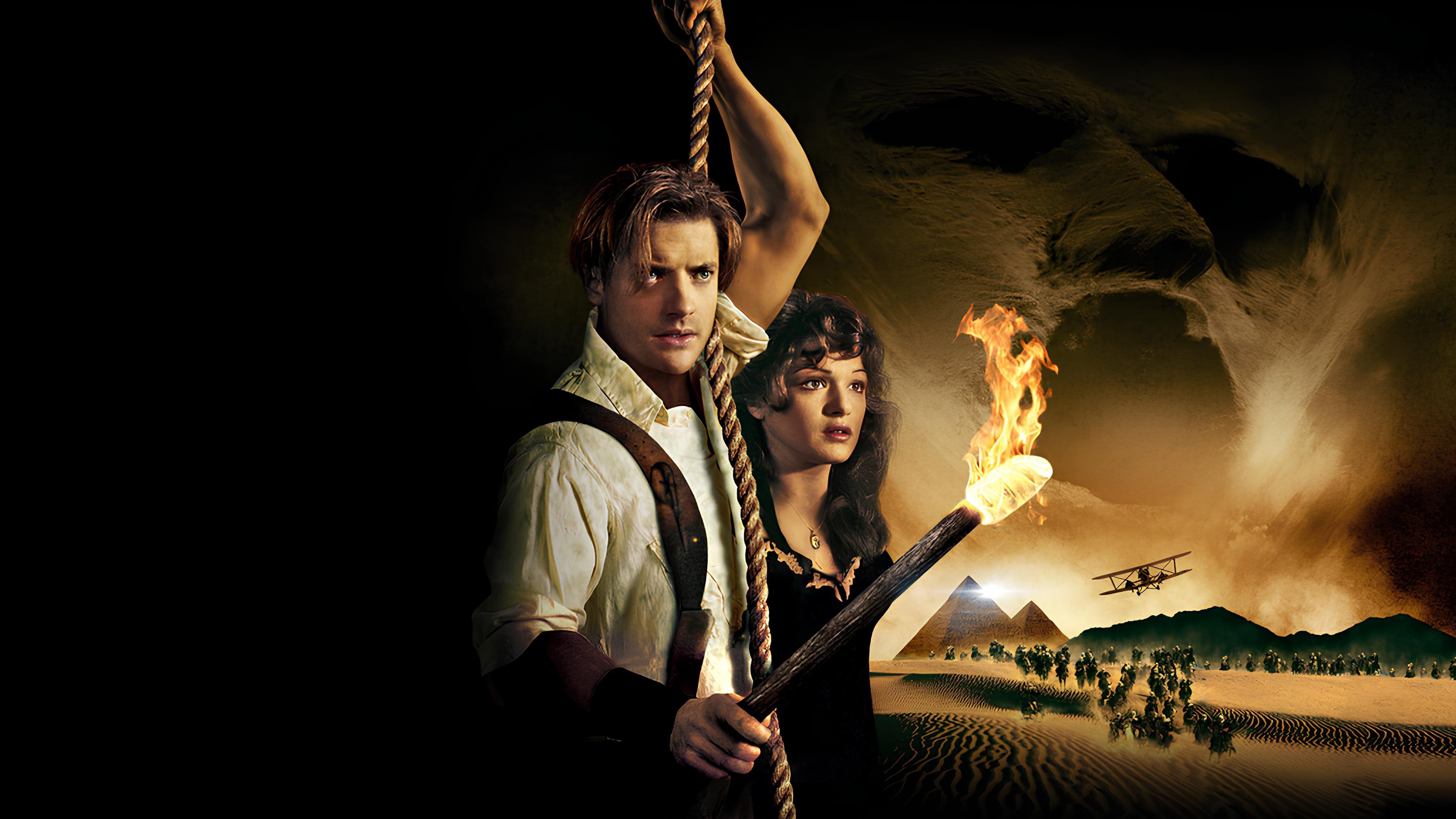
The Mummy
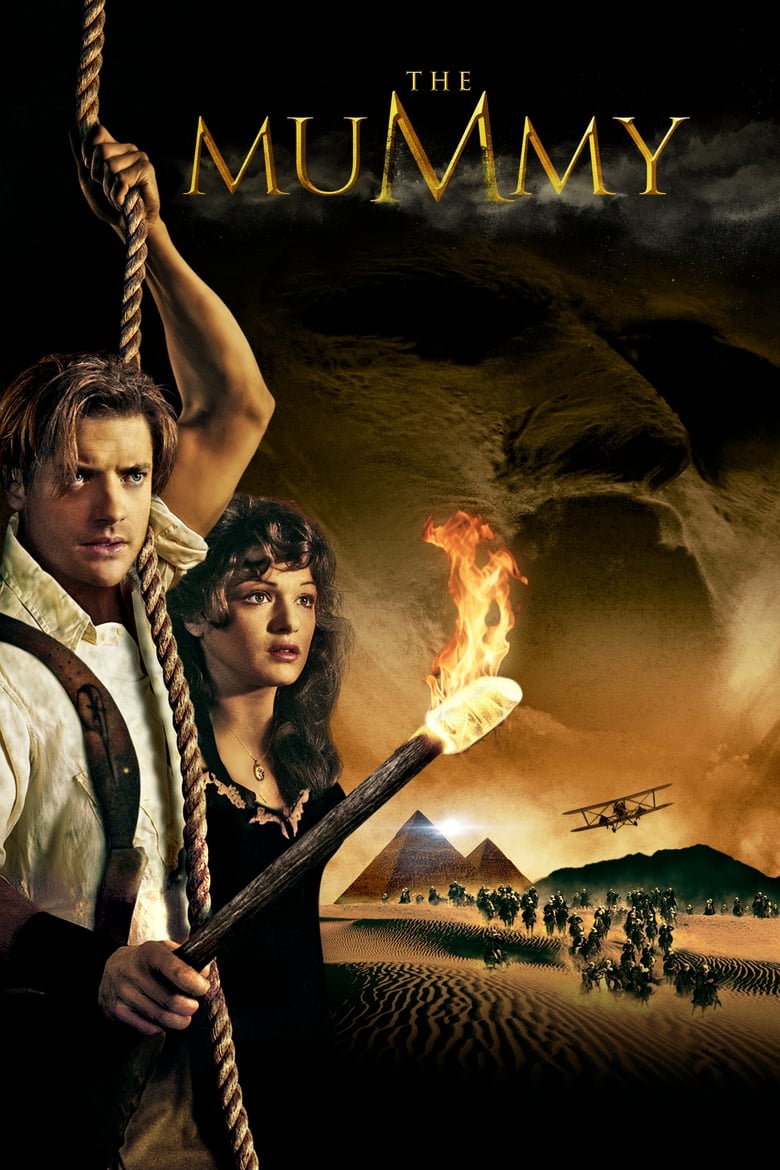
Release Year: 1999
The Resurrection of the Monster: How Stephen Sommers Reengineered Gothic Horror for the Turn of the Millennium
The year 1999 is widely regarded by cinema historians as a watershed moment in American filmmaking, a year that produced boundary-pushing masterpieces like The Matrix, Fight Club, and Magnolia. Yet, nestled alongside these avant-garde giants was a film that achieved a different kind of cinematic alchemy: Stephen Sommers’ The Mummy. Rather than looking forward to the anxieties of the digital age, Sommers looked backward, staging a brilliant, high-wire act of genre hybridization that revived Universal Pictures' classic monster heritage through the lens of late-1990s blockbuster maximalism.
To understand the historical significance of the 1999 film, one must first look to its ancestor: Karl Freund’s 1932 original starring Boris Karloff. Freund’s film was a product of German Expressionism transplanted to Hollywood—a slow, atmospheric, and deeply romantic tragedy of grief and reincarnation. When Universal sought to revive the franchise in the late 1990s, visionary directors like Clive Barker, Joe Dante, and George A. Romero were initially attached, each proposing dark, low-budget horror concepts. Sommers’ stroke of genius was to reject the solemnity of contemporary horror in favor of a swashbuckling, romantic-adventure epic. In doing so, he did not merely remake The Mummy; he recontextualized it, fusing the DNA of classic Hollywood adventure (such as Michael Curtiz’s The Adventures of Robin Hood) with the kinetic pacing of Steven Spielberg’s Indiana Jones franchise and the emerging possibilities of computer-generated imagery (CGI).
Thematic Deconstruction: Modernity, Colonialism, and the Price of Hubris
At its core, The Mummy operates on a series of profound thematic dualities that elevate it above the standard popcorn fare of its era. The narrative is driven by the friction between the ancient and the modern, the rational and the mystical, and the colonizer and the colonized.
1. The Clash of Eras: Modernity vs. Antiquity
Set in 1923, the film takes place in a world transitioning away from the devastation of the First World War. This era is defined by technological acceleration—biplanes, automatic pistols, and scientific archaeology are the tools of the Western protagonists. Opposing this is Imhotep, a relic of 1290 BC, who wields the elemental, primordial forces of the Egyptian pantheon.
This clash is visually and narratively dramatized through the characters' weapons. Rick O’Connell and his American mercenary counterparts rely on firepower, yet their bullets are useless against the supernatural plague of Imhotep. Conversely, the ancient curse is not broken by modern science, but by the translation of the Book of Amun-Ra—an act of linguistic and historical preservation. The film suggests that modernity, for all its arrogance and technological superiority, is fragile when confronted with the deep, unresolved currents of human history and myth.
2. Orientalism and the Subversion of the Colonial Gaze
As a cinema text, The Mummy occupies a fascinating position within the discourse of Orientalism. On one hand, it utilizes classic tropes of the "exotic, dangerous East"—a landscape of shifting sands, ancient curses, and treacherous locals. However, Sommers’ screenplay frequently satirizes and deconstructs these colonial attitudes through its characters:
- Evelyn Carnahan represents the intellectual bridge. She is half-Egyptian, and her drive is not plunder, but preservation. When she famously declares, "I... am proud of what I am," she is defending her identity as a librarian and scholar against the dismissive, patriarchal British academic establishment.
- The American Mercenaries represent unbridled, crude capitalist imperialism. They view Egypt solely as a vault to be looted. Their ignorance of the culture they are plundering directly leads to their horrific demises, serving as a moral commentary on the destructive nature of colonial greed.
- The Medjai, led by Ardeth Bay, are the ultimate subversion of the "native" trope. Far from being primitive obstacles, they are revealed to be a highly sophisticated, multi-millennial secret society tasked with protecting the world. They are the true heroes of the narrative, possessing a moral clarity and historical understanding that the Westerners lack.
3. Forbidden Love, Hubris, and Damnation
The catalyst for the entire narrative is not a desire for world domination, but a transgressive love affair. Imhotep and Anck-su-namun’s love violates the sacred laws of the Pharaoh, leading to their violent demises. Imhotep’s curse, the Hom-Dai, is a punishment born of institutional cruelty.
By framing Imhotep’s villainy around a desperate, eternal quest to resurrect his lost love, the film imbues its monster with a tragic, operatic pathos. Imhotep is a monster of absolute hubris, but his motivations are deeply human. This mirrors the romance between Rick and Evelyn; both couples are willing to cross boundaries—geographical, social, and even mortal—for one another, positioning love as the ultimate force capable of disrupting the natural order of life and death.
The Aesthetic Architecture: Visual Style, Cinematography, and the Digital Frontier
Visually, The Mummy is a masterclass in late-90s blockbuster aestheticism, balancing physical scale with pioneering digital effects. The film’s visual language is defined by its warmth, its kinetic camera movement, and a deliberate nod to the golden age of cinema illustration.
The Golden Palette of Adrian Biddle
Cinematographer Adrian Biddle (who also shot Aliens and The Princess Bride) bathed the film in a rich, amber-and-gold color palette. The desert is not depicted as a barren wasteland, but as a luminous, romantic canvas. Biddle utilizes high-contrast lighting to create a sense of mythic scale, particularly in the night sequences at Hamunaptra, where the ruins are illuminated by torches and the blue-black velvet of the desert sky.
This warmth directly contrasts with the cold, sterile, and gray tones of the London prologue and the Cairo museum interiors. This color coding establishes Egypt as a place of vibrant, dangerous life, where the past is actively breathing beneath the sand.
The Digital Revolution: Industrial Light & Magic
In 1999, CGI was still in its relative infancy, but The Mummy pushed the boundaries of digital character creation. Industrial Light & Magic (ILM), under the supervision of John Andrew Berton Jr., created a digital antagonist that was seamlessly integrated into live-action environments.
The depiction of Imhotep’s regeneration—progressing from a skeletal, decaying corpse to a fully formed human—was a technical marvel. ILM combined practical prosthetics (designed by Nick Dudman) with digital overlays, ensuring that the mummy always possessed a tangible, physical weight. The iconic sandstorm sequence, where Imhotep’s face forms in a massive wall of dust, remains a landmark achievement in fluid dynamics and digital character animation, perfectly marrying elemental nature with supernatural terror.
Kinetic Mise-en-Scène and Physical Comedy
Sommers’ directorial style is characterized by a restless, sweeping camera that emphasizes spatial geography. During the battle of Hamunaptra, the camera tracks fluidly through trenches and ruins, keeping the audience oriented amidst the chaos.
Furthermore, the visual style borrows heavily from silent-era slapstick. The choreography of the action sequences—particularly Rick’s frantic gunfights and Jonathan’s bumbling escapes—owes a debt to Buster Keaton. This physical comedy balances the horror elements, ensuring the film never descends into grimness, maintaining its tone of joyous, escapist adventure.
Character Archetypes and Performance Analysis
The enduring legacy of The Mummy is largely due to its impeccable casting and the chemistry of its ensemble, which subverted traditional action-movie archetypes of the late 20th century.
| Character | Actor | Archetype Subversion | Narrative Function |
|---|---|---|---|
| Rick O'Connell | Brendan Fraser | The Vulnerable Swashbuckler. Unlike the hyper-masculine, stoic action stars of the 80s (Stallone, Schwarzenegger), Fraser’s Rick is expressive, fearful, and deeply human. He screams in terror, relies on luck, and openly respects his female counterpart's intellect. | The physical protector and guide; the pragmatic anchor of the group. |
| Evelyn Carnahan | Rachel Weisz | The Intellectual Heroine. Evelyn is not a damsel in distress; her knowledge of ancient Egyptian history, languages, and rituals is the group's most valuable weapon. Her bravery is rooted in curiosity rather than physical prowess. | The narrative catalyst and intellectual savior; the heart of the film's historical curiosity. |
| Imhotep | Arnold Vosloo | The Tragic Antagonist. Vosloo plays Imhotep with a quiet, intense sensuality and physical majesty. He is not a mindless brute, but a grieving, powerful priest driven by a singular, romantic obsession. | The supernatural threat; a personification of the ancient past's unyielding power. |
| Beni Gabor | Kevin J. O'Connor | The Cowardly Opportunist. Beni is a dark mirror to Rick. While Rick adapts through courage and loyalty, Beni survives through craven adaptability, switching languages and religions to appease whoever holds power. | Comic relief and a thematic representation of moral decay and colonial opportunism. |
Critical Verdict: Why The Mummy Endures
In the decades since its release, The Mummy has undergone a significant critical reappraisal. Initially dismissed by some contemporary critics as a loud, CGI-laden derivative of Indiana Jones, the film has aged far better than many of its peers. It stands as a monument to a lost era of blockbuster filmmaking—one that relied on mid-budget ingenuity, practical set construction, charismatic star power, and a genuine sense of fun, before the monoculture of superhero franchises and sterile green-screen environments took hold.
The film’s tonal balance is its greatest achievement. It operates as a genuine horror film—featuring body horror, plagues, and terrifying demises—while simultaneously functioning as a sweeping romance, a laugh-out-loud comedy, and a thrilling action-adventure. To balance these disparate genres without succumbing to tonal whiplash requires a level of directorial precision that Stephen Sommers rarely received credit for at the time.
Conclusion
Stephen Sommers’ The Mummy is a triumphant celebration of cinema's past and a showcase of its technological future. By synthesizing the gothic romance of the 1930s, the swashbuckling energy of the 1930s and 40s, and the digital wizardry of the late 1990s, the film created a timeless, cross-generational classic. It proved that monsters do not always need to lurk in the shadows of expressionistic dread; sometimes, they are best met in the blinding, golden light of the Egyptian desert, challenged by a librarian, a soldier of fortune, and the enduring power of human love. It remains a high-water mark of Hollywood entertainment, a film that, much like its titular antagonist, refuses to be forgotten, continuing to rise from the sands of time to enchant new generations of cinephiles.