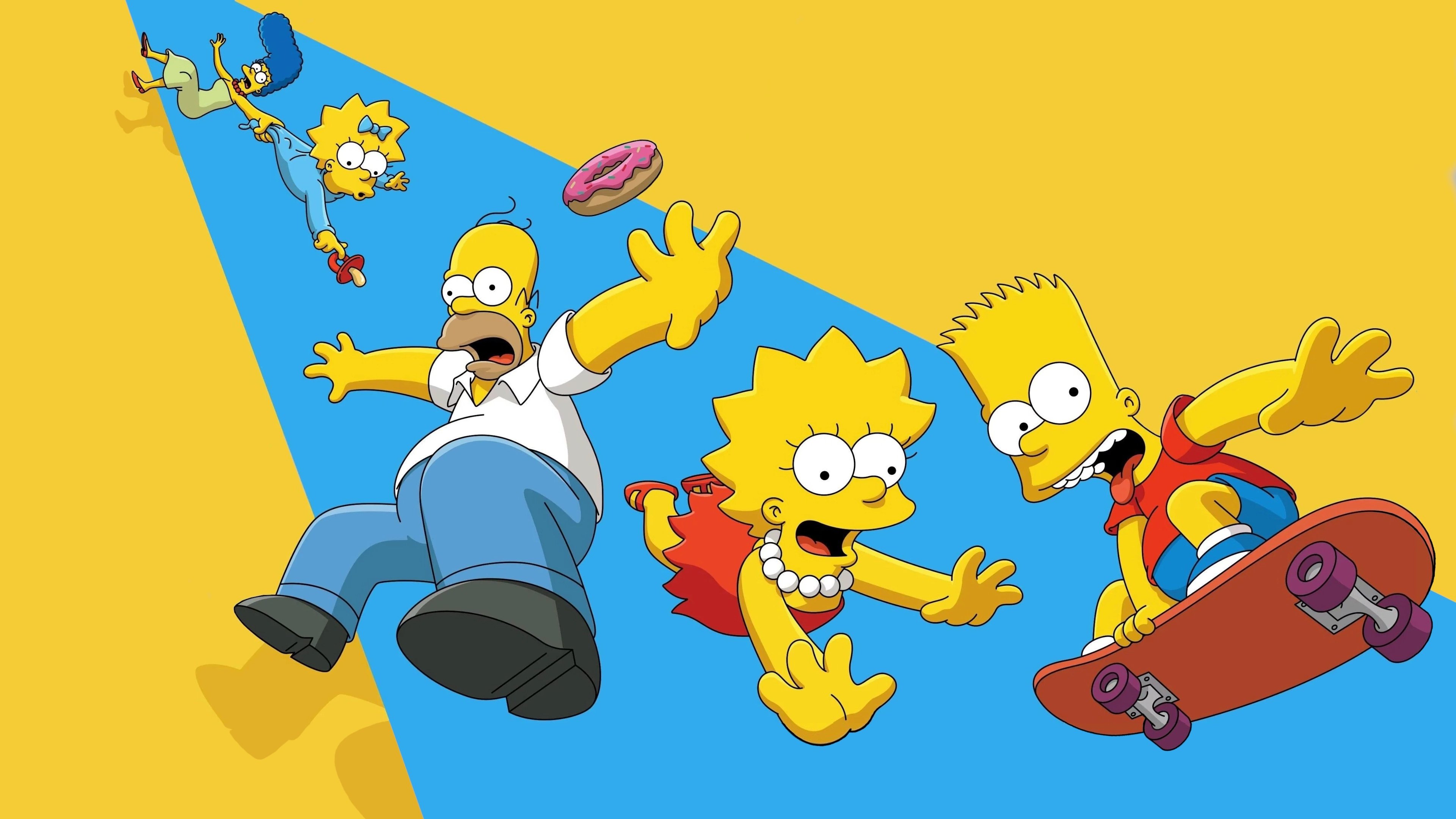
THE SIMPSONS
Archive Entry No. 1989-PR
The Springfield Mirror: Anatomy of America’s Longest-Running Satirical Microcosm
Since its debut on December 17, 1989, Matt Groening’s The Simpsons has operated as more than mere television; it is a sprawling, post-modern tapestry of American decline and resilience. What began as a crude counter-cultural antidote to the sanitized domesticity of the late-1980s sitcom has evolved into a monumental sociological artifact. To dissect the series is to examine the machinery of late-stage capitalism, the disintegration of civic institutions, and the enduring myth of the nuclear family through a highly sophisticated comedic lens.
The Elastic Geography of Springfield
Springfield is not merely a setting; it is a brilliant exercise in elastic world-building. Geographically indeterminate and politically corrupt, the town serves as a malleable microcosm of the United States. Groening and his writers constructed a municipal sandbox where the nuclear power plant, the elementary school, the church, and Moe’s Tavern exist in a state of perpetual, symbiotic friction. This world-building is distinct because of its functional fluidity. The town adapts to the narrative needs of any given week—a gorge can appear on the outskirts of town, or a monorail can bisect the downtown—yet it retains a rigid institutional permanence. Springfield’s citizenry, from the predatory capitalist Mr. Burns to the sycophantic Waylon Smithers, form a dense, Dickensian ecosystem of archetypes that allows the series to satirize every facet of modern life without ever leaving its borders.
The Paradox of the Static Arc
In traditional television, character development is linear. In The Simpsons, however, we encounter the paradox of the static arc. Because the characters are trapped in an eternal present—where Bart is forever ten and Maggie never speaks—their growth cannot be chronological. Instead, their development is depth-oriented. Homer Simpson is not merely a buffoon; he is a tragicomic representation of the American id, torn between base desires and a profound, if clumsy, love for his family. Marge represents the domestic martyr, her gravelly voice a physical manifestation of compromised dreams. Lisa stands as the perpetual Cassandra, an intellectual isolated within her own lineage, while Bart embodies the fading promise of Gen-X rebellion. Their arcs do not progress toward resolution; rather, they deepen through repetition, exploring the tragic beauty of a family that is fundamentally broken yet eternally bound together.
The Evolution of Narrative Velocity
The narrative pacing of The Simpsons offers a fascinating study in cultural acceleration. In its seminal early seasons, the show moved with a deliberate, character-driven leisure, heavily influenced by the emotional realism of James L. Brooks. However, as the series entered its "Golden Era" (roughly seasons three through nine), the pacing underwent a revolutionary transformation. The narrative structure became a marvel of hyper-dense, multi-tiered pacing. Episodes began with seemingly unrelated first acts that seamlessly dissolved into the main plot, propelled by a relentless barrage of visual gags, cultural allusions, and meta-commentary. This rapid-fire pacing anticipated the fragmented attention spans of the internet age, transforming the sitcom format from a linear narrative into a dense, semiotic collage.
Ultimately, The Simpsons remains a monumental achievement in television history. By masterfully balancing an expansive, shifting world with deeply human, structurally frozen characters, it created a mirror that has reflected—and predicted—the anxieties of a nation for over three decades.