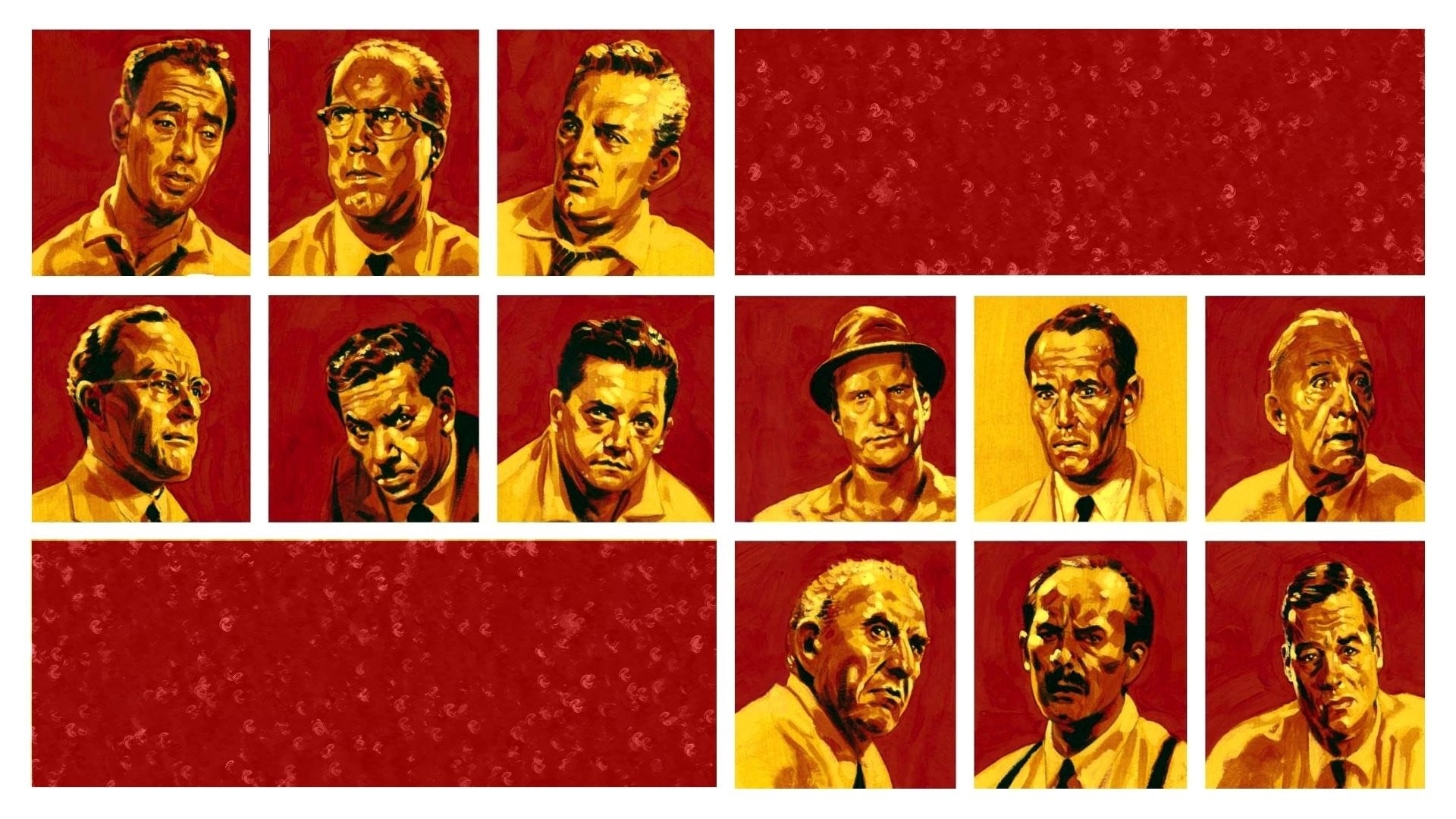
12 ANGRY MEN
Archive Entry No. 1957-PR
An Anatomy of Tension: A Retrospective on Sidney Lumet’s 12 Angry Men
Released in the spring of 1957, Sidney Lumet’s feature directorial debut, 12 Angry Men, remains a towering achievement of American realist cinema. What begins as a seemingly open-and-shut case of patricide transforms into a microscopic examination of the American soul. It is a film that eschews the grand, widescreen spectacles of its era, choosing instead to find its universe within the sweltering, claustrophobic confines of a single jury room. More than six decades later, this black-and-white masterpiece continues to instruct us on the mechanics of human prejudice and the fragile architecture of democracy.
The Crucible of Justice: Enduring Themes
At the heart of the film lies a profound interrogation of the democratic experiment. Lumet, working from Reginald Rose’s brilliant teleplay, uses the jury room as a crucible to test the integrity of "reasonable doubt." The film’s enduring power is rooted in its refusal to offer easy moral comforting. Instead, it exposes how personal prejudices, class anxieties, and racial biases corrupt the pursuit of truth. Juror 8, played with quiet, humanist dignity by Henry Fonda, is not a crusader possessing absolute knowledge of the defendant's innocence, but rather an avatar for intellectual humility. He simply asks his peers to talk.
Today, the film’s thematic resonance feels remarkably contemporary. In an era defined by echo chambers and tribal polarization, the jurors' initial rush to judgment mirrors our modern digital landscape. The narrative warns us against the seductive ease of apathy—embodied by Jack Warden’s baseball-obsessed Juror 7—and the destructive poison of systemic bigotry, personified by Ed Begley’s Juror 10. It asserts that justice is not a passive guarantee, but an active, exhausting labor of empathy and critical inquiry.
Boris Kaufman’s Claustrophobic Masterclass: Cinematography Today
While the screenplay provides the intellectual scaffolding, it is Boris Kaufman’s cinematography that elevates 12 Angry Men into a visual masterpiece that holds up flawlessly today. Kaufman, a master of light and shadow who previously won an Oscar for On the Waterfront, employs a stealthy, progressive visual strategy that mirrors the rising psychological tension of the room.
Lumet and Kaufman famously divided the shoot into thirds, shifting the camera’s perspective to manipulate the viewer's subconscious. In the first third, the camera is positioned above eye-level, utilizing wide-angle lenses to establish the geography of the room and create a sense of distance. As the debate intensifies in the second third, the camera drops to eye-level, bringing us into intimate confrontation with the men. By the final act, the camera descends below eye-level, shooting slightly upward, while simultaneously switching to longer telephoto lenses.
This focal shift compresses the background, bringing the walls closer to the characters and filling the frame with sweating, desperate faces. This brilliant manipulation of focal length and camera height creates a visceral sense of suffocation that digital-era filmmakers still struggle to replicate. The cinematography does not merely record the drama; it actively inflicts the room's oppressive heat and psychological pressure upon the audience.
The Legacy of Lumet’s Debut
Decades after its release, 12 Angry Men remains the gold standard for chamber dramas and courtroom thrillers. It proved that cinematic dynamism does not require expansive landscapes or explosive action; it requires a deep understanding of human behavior and spatial geometry. The film’s legacy is evident in everything from the dialogue-driven tension of Quentin Tarantino’s The Hateful Eight to the claustrophobic legal maneuvering of modern television dramas.
Ultimately, 12 Angry Men is a testament to the power of the singular voice standing against the tide of conformity. By focusing on the faces of twelve ordinary men, Lumet created an extraordinary, timeless monument to human decency, proving that the smallest rooms can contain the grandest ideas.